
26 Feb The Neuroscience of Focus: Beyond Willpower
Many assume that focus is an innate quality—that some people naturally possess strong concentration while others are simply “distractible.” Neuroscience, however, paints a more nuanced picture. Concentration isn’t a fixed personality trait or a moral failing; it is a fleeting neural configuration shaped by how various brain systems interact dynamically at any given moment.
A prime illustration of this is the flow state.
Understanding Flow
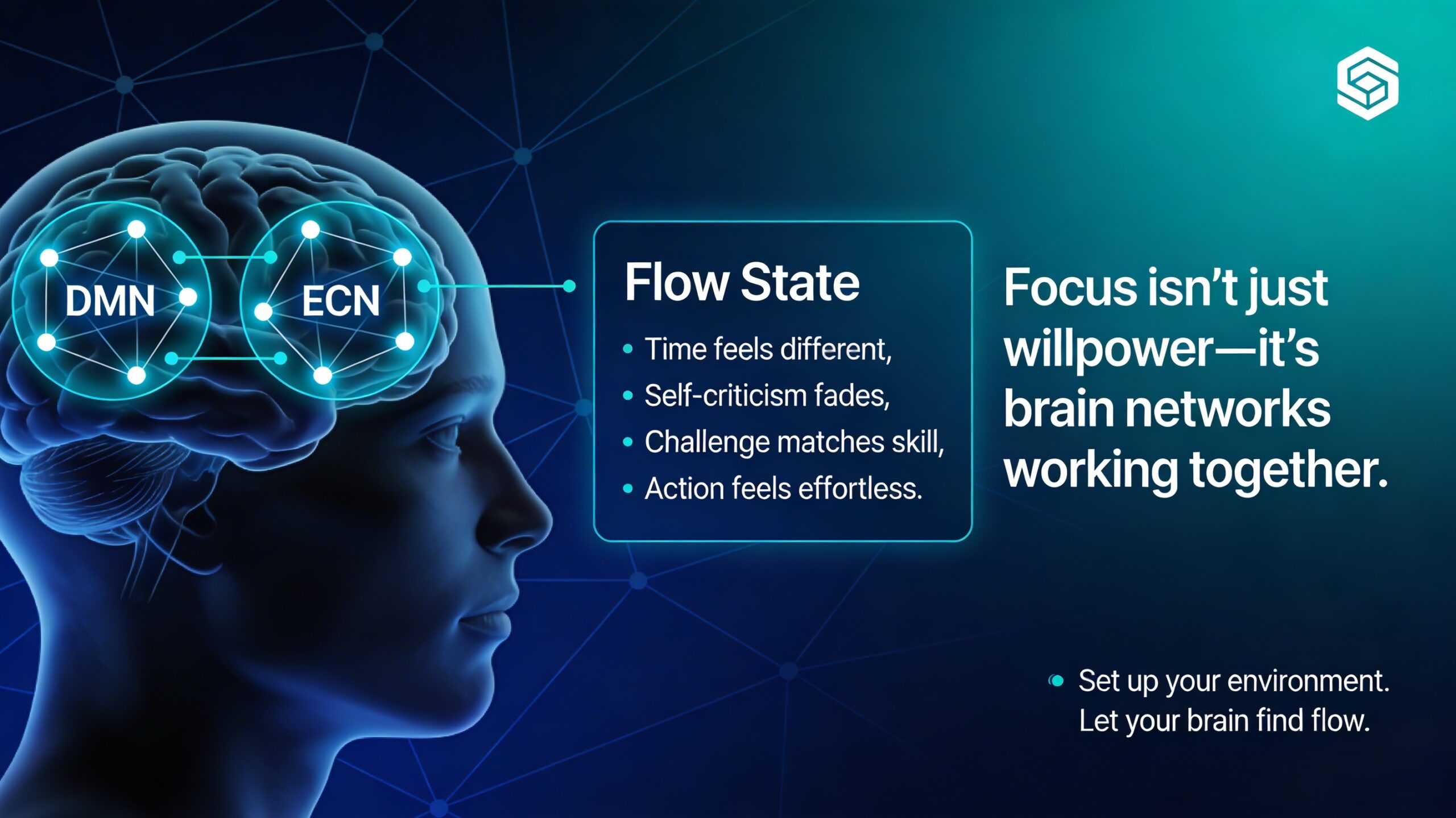
Flow describes that immersive experience where you’re fully engaged in an activity. In this zone:
- Time Distortion: Hours seem to slip away unnoticed.
- Reduced Self-Consciousness: Internal rumination and “ego” fade away.
- The “Sweet Spot”: The challenge matches your skills perfectly.
- Effortless Action: Tasks feel fluid and intuitive rather than labored.
Key Brain Networks Involved in Attention
Two major large-scale systems play starring roles here:
1. The Default Mode Network (DMN): This circuit activates during inward-focused moments. It handles mind-wandering, personal reflection, and internal self-evaluation (“Am I doing this right?”). While valuable for introspection, the DMN can interfere when external focus is needed.
2. The Executive Control Network (ECN): This system drives purposeful, goal-oriented behavior. It manages sustained attention, working memory, and the inhibition of distractions.
Traditionally, researchers viewed these networks as a “seesaw”—one ramps up while the other quiets down. Flow challenges this simple model.
The Discovery: Network Integration
Contrary to the classic pattern where these networks oppose each other, flow features increased functional connectivity between them. Rather than one silencing the other, they synchronize and collaborate. This cooperation enables:
- Spontaneous Idea Generation: Contributions from the DMN.
- Precise, Controlled Execution: Guidance via the ECN.
- Blending Creativity with Discipline: Flow emerges from harmonious orchestration across the brain.
Why Flow Feels Effortless
Beyond attention, flow reshapes your emotional tone. Threat-related signals (from the amygdala) diminish, while internal reward circuits activate strongly. This creates a calm, intrinsically motivating state. Because the brain dials back excessive self-observation, you stop critiquing every move and simply act—explaining why overthinking sabotages performance while “letting go” enhances it.
Real-World Implications
Flow isn’t a mystical talent reserved for geniuses; it is accessible but fragile. Modern distractions—pings, multitasking, and perfectionism—prevent the brain from settling into this mode. When flow is absent, we often label ourselves as “lazy” or “burned out.” In reality, the issue usually lies in the environment and the disrupted conditions for this optimal brain state.
Key Takeaway: True concentration isn’t about grinding through willpower. It’s about setting up the environment and mindset so your brain networks stop clashing and start cooperating.
Sorry, the comment form is closed at this time.